Getting started¤
JAXScape is a minimal JAX library for connectivity analysis at scales. It provide key utilities to build your own connectivity analysis workflow, including
- differentiable and GPU-accelerated graph distance metrics
- differentiable raster to graph and graph to raster mappings
- moving window utilities for implementing large-scale connectivity analysis pipelines
JAXScape leverages JAX's capabilities to accelerate distance computations on CPUs/GPUs/TPUs, while ensuring differentiability of all implemented classes and methods for awesome sensitivity analysis and optimization.
Installation¤
uv add jaxscape
The default installation is CPU-only. For NVIDIA GPUs, use uv add 'jaxscape[cuda]', or install JAX following the official JAX installation guide. JAXScape will automatically use the JAX backend you have configured.
You may be required to install optional linear solvers for large-scale resistance distance computations. CholmodSolver, PyAMGSolver, and AMJaxCGSolver are documented on the linear solver page, including the one-time init_preconditioner(...) workflow used by AMJaxCGSolver for JIT-compiled and differentiable repeated solves.
Resistance distance methods¤
ResistanceDistance() computes exact resistance distances by default. For
larger graphs, use the Spielman-Srivastava randomized approximation by selecting
an explicit method object:
from jaxscape import ResistanceDistance, SpielmanApproximation
from jaxscape.solvers import PyAMGSolver

distance = ResistanceDistance(
    method=SpielmanApproximation(epsilon=0.05, seed=0),
    solver=PyAMGSolver(),
)
The epsilon parameter belongs to SpielmanApproximation: smaller values use
more random projections and typically improve accuracy at higher memory and
solve cost. The approximate method remains compatible with jax.grad via a
custom implicit-differentiation rule.
Quick start¤
1. Download sample data
curl -sL https://github.com/vboussange/jaxscape/releases/download/v0.0.6/data.zip -o data.zip && unzip -q data.zip && rm data.zip
2. Run the analysis
import numpy as np
import matplotlib.pyplot as plt
import jax.numpy as jnp
from jaxscape import GridGraph
from jaxscape import LCPDistance, ResistanceDistance, RSPDistance

permeability = jnp.array(np.loadtxt("data/permeability.csv", delimiter=",")) + 0.001
barriers = np.asarray(permeability <= 0.1)

# Create a grid graph where edge weights are the average permeability of the two nodes
grid = GridGraph(grid=permeability, fun=lambda x, y: (x + y) / 2)

# We set the source to the top left pixel, and compute distances to all other pixels with three different distance metrics
source = grid.coord_to_index(jnp.array([0]), jnp.array([0]))

distances = {
    "LCP distance": LCPDistance(),
    "Resistance distance": ResistanceDistance(),
    "RSP distance": RSPDistance(theta=0.01, cost=lambda x: -jnp.log(x)),
}

distance_cmap = plt.cm.magma.copy()
distance_cmap.set_bad(color="lightgray")

fig, axs = plt.subplots(1, 4, figsize=(12, 4))

permeability_im = axs[0].imshow(permeability, cmap="gray", vmin=0, vmax=1)
axs[0].set_xticks([])
axs[0].set_yticks([])
for spine in axs[0].spines.values():
    spine.set_visible(True)
axs[0].set_title("Permeability")
fig.colorbar(permeability_im, ax=axs[0], shrink=0.2)

for ax, (title, distance) in zip(axs[1:], distances.items()):
    # Compute distances from all nodes to the source
    dist_to_node = distance(grid, source)

    # Convert from node values to a 2D array and hide barrier cells
    dist_array = np.asarray(grid.node_values_to_array(dist_to_node.ravel()))
    dist_array = np.ma.masked_where(barriers, dist_array)

    # Plotting
    im = ax.imshow(dist_array, cmap=distance_cmap)
    ax.axis("off")
    ax.set_title(title)
    fig.colorbar(im, ax=ax, shrink=0.2)

fig.suptitle("Permeability and distance to the top-left pixel")
plt.tight_layout()
plt.show()
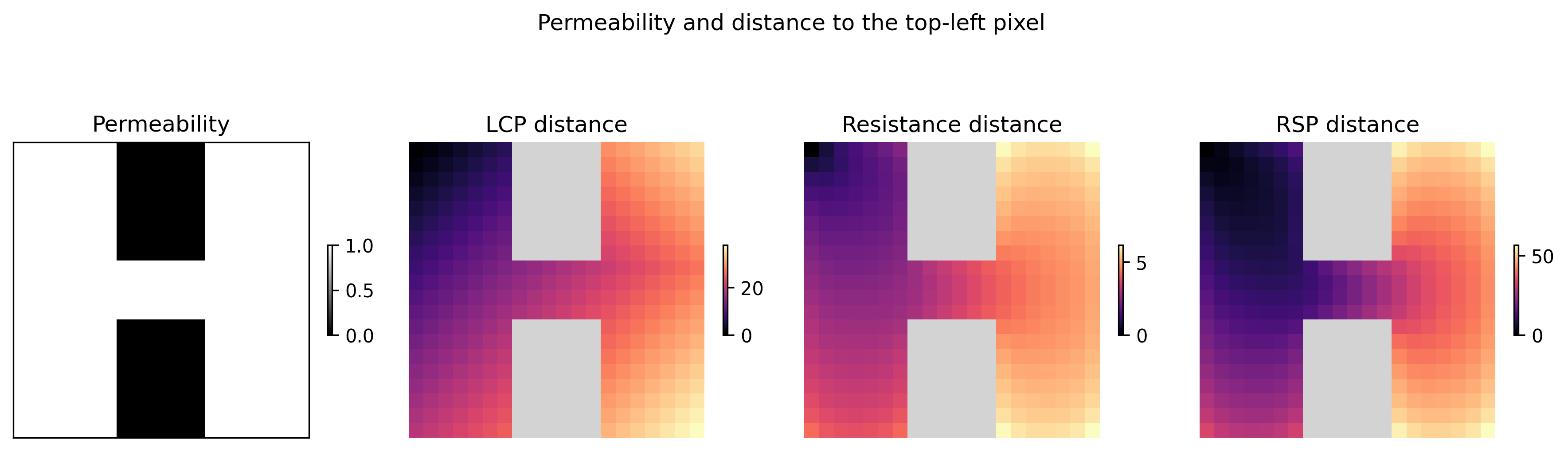
But what's really cool about jaxscape is that you can autodiff through thoses distances! Check out the Examples section to learn about applications and more!
Features and roadmap 🚀¤
See issues; most notably:
- [ ] Support for direct and iterative linear sparse solvers on GPU (cf spineax)
- [ ] Benchmark against
CircuitScape,ConScape.jlandradish.
License¤
jaxscape is distributed under the terms of the MIT license.
Related packages¤
- gdistance
- ConScape
- Circuitscape
- graphhab
- conefor
- resistanceGA
- landscapemetrics
- radish
Citation¤
If you use JAXScape in your research, please cite:
@software{jaxscape2024,
  author = {Boussange, Victor},
  title = {JAXScape: A minimal JAX library for connectivity modelling at scale},
  year = {2025},
  doi = {10.5281/zenodo.15267703},
  url = {https://github.com/vboussange/jaxscape}
}